Even Google Goes Down. What Happens to Your Site When It Does ?

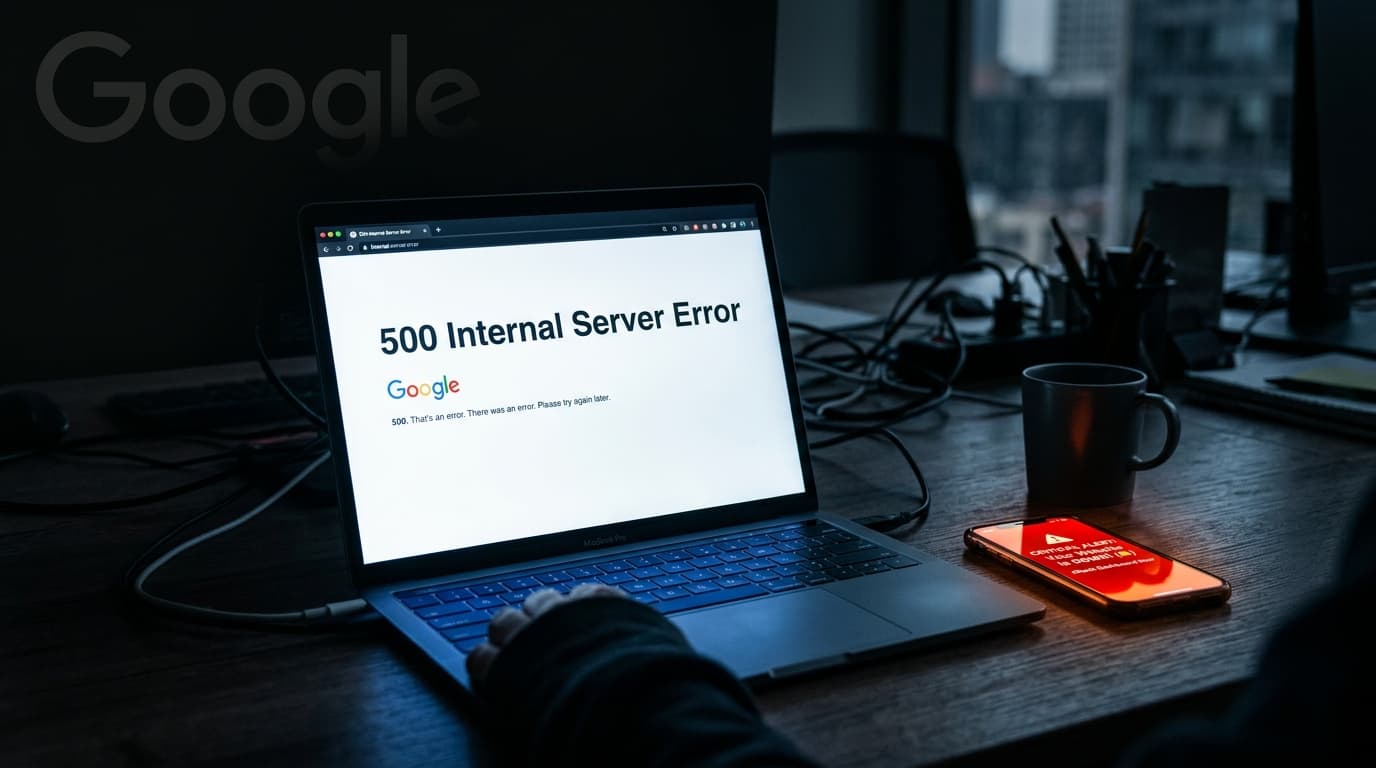
On Tuesday, May 12, 2026 - Google Search broke.
Not for a second. Not for a handful of users. For over an hour, thousands of people across India, Europe, Australia, and the US were staring at a "500 Internal Server Error" page where their search results should have been.
Over 3,300 complaints hit Downdetector in India alone within minutes. Twitter (X) went into full meltdown. Someone posted: "Man, a Google outage is rare. The 4 horsemen are incoming."
And Google said… nothing. No status page update. No tweet. No acknowledgment.
That silence is the whole story.
What Actually Happened
Around 10:00 a.m. IST, Google Search started returning HTTP 500 errors on both mobile and desktop. Queries were failing, pages weren't loading, and even Google's own diagnostic pages were harder to reach.
The complaint breakdown on Downdetector:
- ~57% — Search completely failing
- ~28% — content not loading even when the page opened
- ~12% — general website access issues
Gmail, YouTube, Maps, and Google Ads were untouched. This was a Search-layer problem — not a full Google infrastructure collapse. But for the millions of people who rely on Search as their default internet on-ramp, it didn't matter.
It was down. And nobody official told them.
Google Didn't Say a Word
That's the part nobody talks about enough.
Google's status dashboard showed green across the board the entire time. No incident. No estimated fix time. No "we're aware of the issue."
The only thing users got was the 500 error page's boilerplate: "Our engineers have been notified and are working to resolve the issue."
A canned message baked into an error page is not a status update.
Businesses running SEO-dependent traffic? Organic referrals dropped in real time. Freelancers on deadline? Stuck. E-commerce sites waiting for Google to surface them? Invisible for an hour.
Nobody got a heads-up.
Why This Matters for Your Website (Not Google's)
Here's the uncomfortable part: if Google — with tens of thousands of engineers and an SLA of "basically always up" — can go dark for an hour without telling anyone...
What's your site doing right now?
Most website owners find out their site is down the same way Google's users found out Google was down — from someone else. A frustrated client email. A DM from a user. A tweet you weren't tagged in.
By the time you find out, the damage is done.
The "Phone on Silent" Problem
This is exactly what SIOPS is built for.
Your site goes down at 2 a.m. Your phone is on silent. You're asleep. Your client's customer tries to visit, gets an error, and leaves. Maybe forever.
SIOPS doesn't send you a notification that gets buried in a notification tray.
It wakes you up.
How SIOPS handles it:
- ✅ Checks your site every 1 minute from multiple locations
- ✅ Sends an in-app alarm that bypasses silent/DND mode
- ✅ Calls your phone if you don't respond
- ✅ Also hits Slack, email, push notification, and webhooks
- ✅ Gives your users a public status page so they're not left guessing
- ✅ 2-minute setup. No sysadmin required.
The Lesson From May 12
The Google outage resolved itself in about an hour. No one published a root cause. No post-mortem. The status dashboard is still green.
That's fine for Google — they can weather an hour of silence.
Your freelance client, your SaaS startup, your agency's dashboard — can't.
Every minute your site is down without you knowing is a minute someone is forming an opinion about your reliability.
Don't let a Downdetector spike be how you find out.
→ Monitor your first site free
SIOPS is a mobile-first uptime monitoring tool built for freelancers and developers. Fix it before they notice.