The 3am Test: Would Your Monitoring Tool Actually Wake You Up?

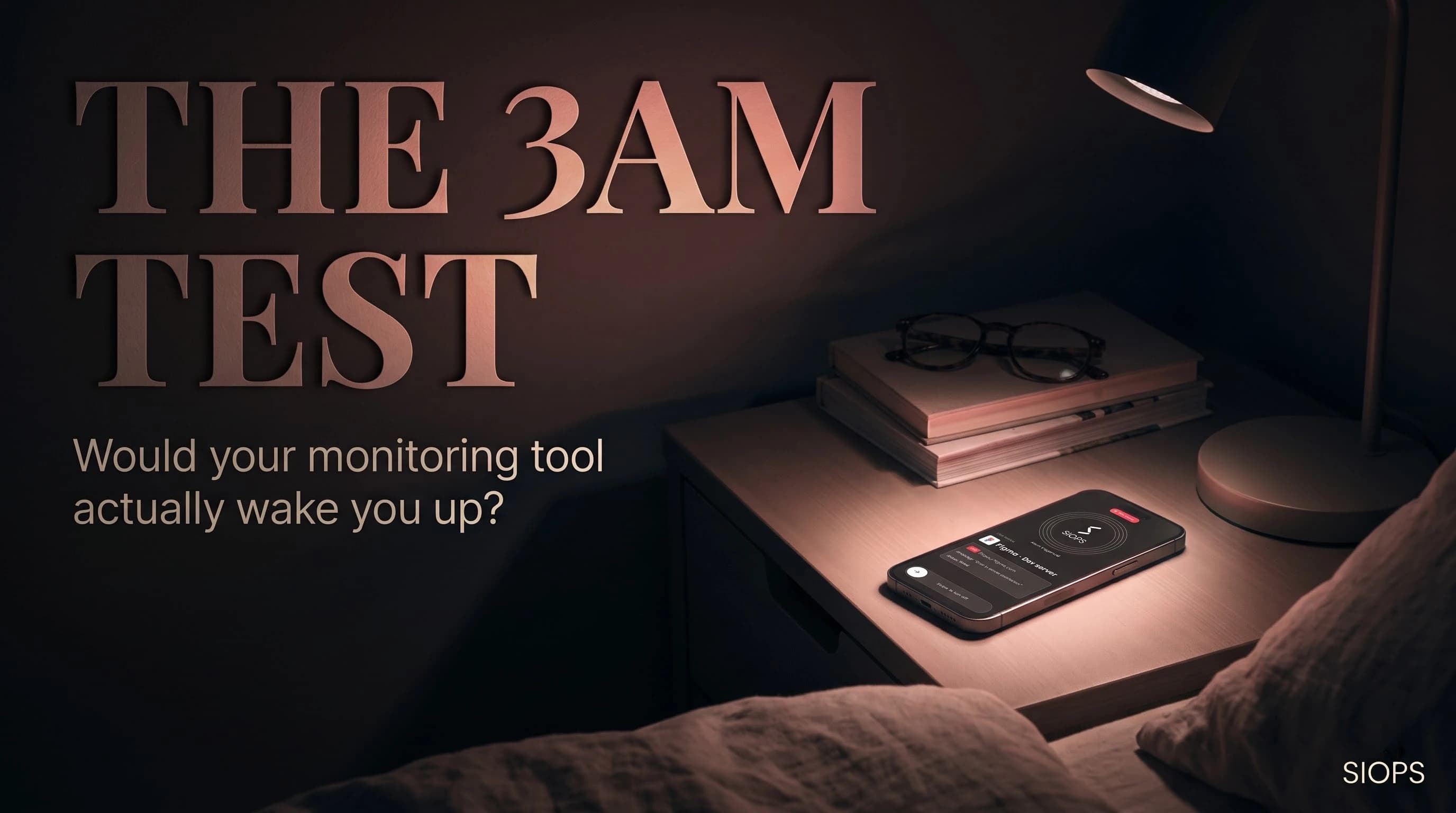
Ask anyone paying for uptime monitoring whether it'll wake them up if a client's site goes down overnight, and almost everyone says yes without hesitating. Almost nobody has actually tested it. They're going off the fact that the tool sends alerts, not off any evidence that those alerts survive contact with a phone on silent at 2am.
There's a five minute test that answers the question for real. Most people who run it are surprised by what they find.
The Test
Put your phone on Do Not Disturb, the same setting you'd actually have on overnight. Then trigger a failure on something your monitoring tool is watching. If you can safely take a test site offline for a minute, do that. If not, most monitoring dashboards have a way to send a test alert or force-check a monitor you've temporarily misconfigured to fail.
Set your phone down, face up or face down, wherever it actually sits at night. Wait for the alert.
If your phone stays silent, you have your answer. Not in theory, not based on what the pricing page promised, but based on what actually happened on the device that's supposed to save you.
Why This Test Exists at All
It exists because the phone companies built a wall specifically to stop this from happening, and most monitoring tools were never built to get through it. Do Not Disturb and Focus modes silence everything by default during set hours, because notification fatigue is real and phone makers decided the fix was blanket silence rather than per-app judgment calls. That's a reasonable design decision for marketing texts and app badge counts. It's a dangerous default for the one alert that's supposed to tell you a client's business is offline.
Most monitoring tools send that alert through the exact same channels Do Not Disturb was built to block: SMS, email, standard push notifications. They're not doing anything wrong by the spec. They're just not doing anything special, and "not special" is exactly what gets filtered out at 3am.
What Passing Actually Requires
For an alert to survive Do Not Disturb, it can't just be a louder version of a normal notification. It has to use a permission tier the phone treats differently at the operating system level. On iOS that's the Critical Alert entitlement, the same one used by earthquake warnings and a small number of vetted safety and medical apps. On Android it's a comparable alarm channel, the kind your morning alarm clock already uses to ring through silent mode. Very few apps get this permission, because Apple and Google both require justification for why an app genuinely needs to interrupt someone regardless of their settings.
That's the real reason most monitoring tools fail the 3am test. Getting the permission is extra engineering work and an extra approval step, and it's an admission that your product's core job is interrupting someone, not politely informing them. Building a nice dashboard and a webhook integration is faster to ship. Most companies ship the faster thing.
Run It On Whatever You're Using Right Now
This isn't a pitch to switch tools before you've checked. Run the test on whatever you currently pay for. If it wakes you up through Do Not Disturb, genuinely, you're covered, and nothing here needs to change. If it doesn't, you've just learned something worth knowing before the next real outage teaches you the same lesson at your client's expense.
SIOPS is built to pass this exact test. The Critical Device Alarm uses the same iOS Critical Alert permission and the equivalent Android alarm channel, specifically so that when something you're monitoring goes down, your phone doesn't get a choice about staying quiet. Every account, free or paid, gets the same alarm behavior. That's not a premium feature. It's the whole reason the product exists.
Run the test tonight on whatever you're using. If it fails, SIOPS starts free and passes it. Get it at siops.app.